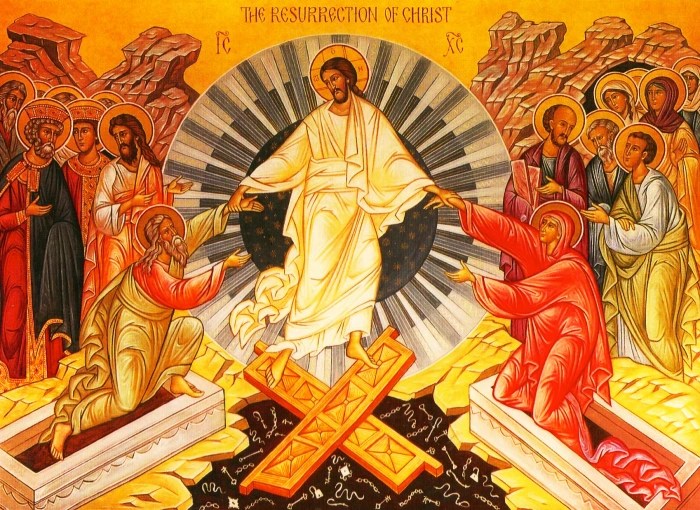
Salvation is not merely about where we go after we die, but about what we are becoming now.
Happy Easter! On this resurrection Sunday, I am inclined to offer a much more detailed account of the purpose of the incarnation, life, death, and resurrection of Christ Jesus. We know the story – the tomb is empty – he is risen and risen indeed. But why? How do we understand the Christ in perspective of our lives as Christians? More pointedly, how might we understand the resurrection in light of the Church’s daring confession: O felix culpa — “O happy fault,” even, the truly necessary sin of Adam?
This blog is going to be a long one, so buckle up!
Many modern Christologies (studies of the Christ) paint Jesus as a liberator, facet of creation, or special revelation to humanity. All of these views are prefaced on a human-originated ontology, where Jesus the man is one in unison with the rest of the created order and can be seen vis-à-vis the life experiences and struggles of humanity. In other words, we can understand Jesus based on our lived experiences or desired outcomes. Granted, Scripture tells us that Jesus came to liberate the captives (Luke 4:18), lead us toward glorification (John 14:6), and reveal the Father’s will (Hebrews 1:1–2). But each of these readings reveals an aspect of Jesus and not the whole Jesus, or totus Christus. As Augustine puts it: “verbum caro factum est, et habitavit in nobis; illi carni adjungitur ecclesia, et fit Christus totus, caput et corpus – The Word was made flesh, and dwelled among us; to that flesh is joined the church, and there is made the whole Christ, head and body.”1 To begin to understand who Jesus is and what he came to save us for (and from) we have to understand who he is in relation to the Father and to the Church.
A totus Christus perspective gives us, as the faithful, the flexibility to see Christ through multiple lenses. First of all, we must accept our human lens—as in, we will never be able to see the fullness of God’s intelligibility. As Augustine reminds us, “If you have understood, then what you have understood is not God.”2 Our knowledge is real, but it is not exhaustive. We speak truthfully, yet always within the limits of creaturely finitude. To confess Christ rightly, then, is to begin not with ourselves, but with God. The Son is eternally begotten of the Father, “God from God, Light from Light.” The incarnation is not the elevation of a particularly enlightened human being, but the condescension of the eternal Word. As Paul the Apostle writes in Philippians 2, Christ “did not consider equality with God something to be exploited, but emptied himself.” This kenosis is not the loss of divinity, but the expression of divine love, a movement outward toward a fallen creation that could not ascend on its own.
And here, we begin to see the contours of the question: was the fall (Adam’s sin) “necessary”? At first glance, the very suggestion seems theologically dangerous. Scripture never presents sin as good, nor as something God positively wills. Sin is rupture, privation, disorder. It is the turning of the creature away from the Creator, the curving inward of the self. As Paul makes clear, “through one man sin entered the world, and death through sin” (Romans 5:12). There is nothing intrinsically redeeming about Adam’s transgression.
And yet, the Church dares to say more.
In the Catholic Easter Vigil, the ancient proclamation rises: O felix culpa, quae talem ac tantum meruit habere redemptorem — “O happy fault that merited for us so great a Redeemer.” The claim is not that sin is good, nor that evil is necessary in itself, but that God, in his providence, has so ordered redemption that the fall becomes the occasion for a greater revelation of divine love than would have otherwise been known. This is not necessity in a causal sense, as though God required sin in order to act. Rather, it is a kind of fittingness or a theological “necessity” only in retrospect. Given that God has acted as he has in Christ, we can now say that the fall has been taken up into a redemptive economy that exceeds its original devastation. Grace does not merely repair; it elevates. Redemption does not simply return us to Eden; it brings us into union with Christ.
This is where Pauline theology presses us further than we might be comfortable going. In Romans 5, Adam and Christ are set in stark parallel: “as one trespass led to condemnation for all, so one act of righteousness leads to justification and life for all” (Romans 5:18). But the symmetry is not equal, as the grace of Christ abounds all the more. The problem introduced in Adam is not merely undone; it is overwhelmed. Likewise, in 1 Corinthians 15, Paul speaks of Christ as the “last Adam,” the inaugurator of a new humanity. “For as in Adam all die, so also in Christ shall all be made alive” (15:22). The movement is not cyclical but eschatological. We are not simply restored to a prelapsarian state; we are drawn into a destiny that Adam himself had not yet attained: incorruptible life in union with the risen Christ.
Thus, the question shifts. The fall is not necessary in the sense of being willed or required by God, but it becomes, through the mystery of divine providence, the stage upon which the fullness of God’s redemptive character is displayed. Without sin, there is no cross; without the cross, no resurrection; without the resurrection, no participation in the life of the risen Christ. And this is where the totus Christus must again take center stage. Christ does not merely accomplish redemption externally; he incorporates us into it. To be “in Christ” is to participate in his death and resurrection. As Paul writes in Galatians 2:20, “I have been crucified with Christ, and it is no longer I who live, but Christ who lives in me.” For salvation is not merely about where we go after we die, but about what we are becoming now, a people being conformed to the image of the Son. The fall fractured humanity; Christ reconstitutes it as a body. Here, Augustine’s vision becomes indispensable. The head and the body together constitute the whole Christ. The Church is not an afterthought to salvation but its very form. The risen Christ is present in and through his people, conforming them to his image, drawing them into his life.
So what, then, of Adam’s sin?
It remains sin: tragic, real, and destructive. But it is not ultimate and does not have the final word. In Christ, even the deepest rupture of creation is taken up and transformed. The wound becomes, mysteriously, the site of healing. The place of death becomes the birthplace of life.
This does not justify sin. It magnifies grace.
And so, on this Easter morning, we do not celebrate the fall, but neither do we despair of it. For in the risen Christ, we see that God is not merely reactive but redemptive in the deepest possible sense. He does not simply undo what has been done; he brings forth something greater.
The tomb is empty, yes. But more than that: the story of Adam has been rewritten in Christ.
O happy fault, indeed.
 Theology Scout
Leave a comment